Okonomiyaki

Grilled as you like it

A new year, a new plan February 4, 2010

A new year is beginning, and we decided quite a while ago that this will be our last year in Japan. That’s right, we’re going home (or somewhere new) in August. As the days pass, I can see the signs of the seasons changing. In the fall, we had our last gorgeous Japanese grapes, our last Japanese persimmons, our last Japanese nashi. Apples are still plentiful at the store, but they’re not as crisp and fragrant as the fall varieties. Just the other day I saw the first ume blossoms of the year. Our last ume (though these will be blooming for months still).

Thinking about all of the wonderful sights, smells, and tastes in Japan that come and go with the seasons, I couldn’t help but realize that we’ve fallen into a routine. I try to make interesting, exciting dinners, but our fall-back easy dinner is rice, salad, miso soup, and grilled salted fish. Ichiyaboshi hokke, shio-jake, shio-saba, sometimes a miso-zuke or kasu-zuke gindara… but the routine is always the same: out of the package and into the broiler. There are so many delicious varieties of fish and seafood available here; they’re super-fresh and really cheap compared to back home in Colorado. So I’m on a mission to eat seafood twice a week. Why twice a week? Well, that’s because burnable garbage day is twice a week (Monday and Thursday), and twice a week will demand some creativity whereas once a week I could fall victim to my own routine-loving laziness. So seafood night is Sunday and Wednesday (so I can put out any bones, shells, or guts in the next day’s trash). It’s not just good for my tastebuds, seafood is full of good stuff like protein, omega-3s, and vitamin E. And seafood is easier on the environment (in some ways) than meats like pork and beef.
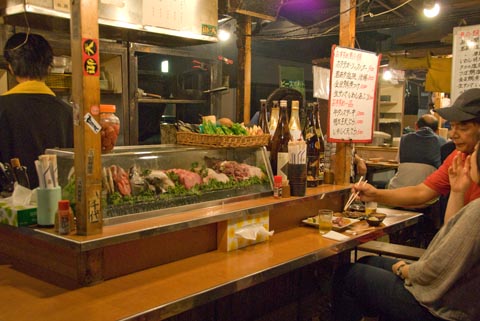
Of course, I don’t want my new dining plan to be wreaking havoc on the seas, so I’ll try to stick to sustainable fish as much as possible. My go-to source is usually Monterey Bay Aquarium’s seafood watch list. Of course, their lists are for customers based in the US, so it’s a little more challenging to find out what’s a good choice and what’s to avoid in Japan, but I’ll do my best. Luckily, I can find the country of origin labeled right on every package at the store here.

While we’re at it, we’re also having vegetari-ish night once a week too. So far it’s been Mondays, but I may be moving my weekly Japanese lessons to Monday night so vegetari-ish night will have to get the boot (probably to Thursday or Saturday). Vegetari-ish night means a mostly vegetarian meal, but since we’re not strictly vegetarians ourselves I’m willing to make exceptions for some flavorful background players like dashi, fish sauce, Worcestershire sauce (well, I don’t have any anyways, but if I did it would be ok), oyster sauce, small amounts of tiny dried shrimp or scallops, or stock (since it’s made from an item that would otherwise be wasted; plus my freezer is tiny, so I can’t keep my chicken stock around forever… if I’ve got it, I’ll use it). There is some continuing debate over whether a small amount (an ounce per person) of bacon, say in a lentil soup or veggie chowder, would still meet the goals of our plan, but we’ve had enough other veggie meals in the week that a little bacon hasn’t thrown any kinks into the plan yet.

So far (well, it’s only been a few weeks), seafood night and veggie night have been a big hit. I feel like I’m thinking more creatively and we’re enjoying the bounty that’s available locally. And I feel like we’re eating more healthily and environmentally.

The inaugural veggie night dinner was saag paneer with homemade paneer (it was a holiday–this is definitely not an after-work recipe if you’ll be making the paneer yourself). The paneer recipe is adapted from Jeffrey Alford and Naomi Duguid’s Mangoes and Curry Leaves, and the saag recipe is based on Madhur Jaffrey’s recipe and this recipe from Olive magazine. Instead of water, I used some of the leftover whey from making paneer as the liquid in the recipe. I liked being able to use something that would have gone to waste otherwise, but it was a little bit more sour than I expected (because of the vinegar in the whey). In the future I’ll probably use a 50/50 mix of whey and water.

Saag Paneer

1 liter milk
1 tablespoon fresh lemon juice or vinegar (I use rice vinegar)

1 to 2 bunches fresh spinach, washed and trimmed
vegetable oil or butter
1 yellow onion
5 garlic cloves
1 to 2 inch piece of fresh ginger
salt
1 tablespoon tomato paste
seeds of 10 cardamom pods
6 cloves
1 tablespoon ground coriander
1 tablespoon ground cumin
1 teaspoon turmeric or curry powder
1/2 teaspoon freshly ground black pepper
dried New Mexico green chile powder to taste
1 cinnamon stick
2 bay leaves
1 teaspoon garam masala

Place the milk in a large pot and heat over medium heat, stirring occasionally to prevent sticking, until it’s just below the boil. Take off the heat. Add the lemon juice and stir with a clean wooden spoon. You will see the curds separate out, looking like blobby bits floating on the surface. Keep on stirring the milk for several minutes, then set aside.

Moisten a piece of cheesecloth or loose-weave cotton cloth (I use Japanese sarashi cloth), place a sieve over a large bowl, and line it with the cloth (fold the cheesecloth so you have several layers to line the sieve). Pour in the the milk mixture. Pour cold water over it to rinse off the taste of the souring agent, then let drain. The liquid will gradually drain through the curds into the bowl: pull the cloth tightly around the curds to press out extra liquid, or tie the top of the cloth to make a bag and hang it on a hook over the bowl to drain. You will have soft moist cheese in about 30 minutes. Transfer to a clean bowl and scrape any remaining curds off the cloth into the bowl.

Next, working with clean wet hads, shape the curds together into a square block. Wrap tightly in cheesecloth or a clean cotton cloth and place on a plate. Put a heavy weight on top to press the moisture out of the cheese. From time to time, pour off any liquid that has accumulated. After 4 hours or so, the cheese will be very firm and drier. Make the paneer a day ahead of time or set aside while you make the saag.

Chop the onion, ginger, and garlic finely. I use a stick blender in a tall, glass measuring cup. Or use a food processor. Blanch the spinach in a large pot of boiling water and then chop (I don’t have a food processor, but you could use one here to chop the spinach finely). Grind the cardamom seeds and cloves in a spice grinder (you can use whole spices, but then you would need to fish them out before you puree the saag. Of course, it’s not a problem if you puree the spinach in a food processor before adding it to the pot. Hmm…).

Heat a large pot over medium heat. Add a bit of butter or vegetable oil. Cook the onion, garlic, and ginger with a pinch of salt until softened and golden. Next add the tomato paste, cardamom, clove, coriander, cumin, turmeric, black pepper, chile powder, and cinnamon stick. Stir and cook for about a minute until fragrant. Add the chopped spinach, bay leaves, and about half a cup to a cup of water. Stir and cook until the spinach becomes tender and well-cooked (at least 20 minutes). Stir occasionally and add more water as necessary. If you haven’t yet, fish out the bay leaves and cinnamon stick and puree the saag. Be careful, it’s hot! Add garam masala and season with salt to taste.

Cut the paneer into bite-sized cubes or triangles. Heat some oil in a cast iron frying pan. Add the paneer to the pan and brown. Turn and continue cooking until hot and browned. Add the paneer to the saag and stir gently (the homemade paneer may crumble easily).

Serve hot with naan or rice.


What’s in my freezer? February 2, 2010

Filed under: Cooking, Eating, Four seasons in Japan, Japan — laurel @ 10:27 pm
Tags: , , ,

Let’s play what’s in my freezer. I’ll give you a hint, it has ten legs and tastes delicious.

If you guessed 6 kilos of frozen snow crab, you’re our big winner! Just delivered today, straight to my door for just 9450 yen. Sure, it’s a lot of money, and we’ll be eating crab like it’s going out of style, but I’ve been meaning to try out some mail-order seafood while we’re here, and it was a price (per kilo) that I just couldn’t pass up. I placed the order on Friday night, and it was delivered C.O.D. on Tuesday at 6:30, right on schedule. After that it just took a few minutes to pack it up into ziploc bags (I had to break off the legs and break them into smaller pieces, but we’d need to do that to eat them anyways) and then came the hard part, squeezing them into my tiny freezer that didn’t have a lot of room to spare in the first place.

My freezer is officially F-U-L-L.


Gas-san and Yudono-san January 22, 2010


lilies blooming near Gas-san’s 8th station

Happy new year! We’ve been away for winter break, but we’re back now, so I’ll pick up where I left off. Here are some more photos from our trip to Dewa Sanzan in Yamagata.

After breakfast at our shukubo on Haguro-san, we walked to the bus stop and rode the bus to Gas-san’s 8th station. Above the station there was a high wetland meadow, the Mida-ga-hara Marsh, with small ponds, green grasses, and blooming lilies and skunk cabbages. We walked around on the planked boardwalks for a bit until we found the real path to the summit.

Misty clouds collected along the path, obscuring the view ahead.

We saw plenty of yamabushi tour groups. We could hear them coming, too, by their tinkling bear-bells. Amazingly, some of these guys were hiking in thin-soled zori shoes instead of hiking boots.


the rippled surface of the melting snow

As we climbed higher, the clouds began to clear up, revealing some amazing views.

In some places, the stone path widened, and seemed almost like a road. Here, some small flowers peek out from their sheltered spot.

We found a large pile of rocks in a sunny spot, so we stopped for a late-morning snack.


The three peaks of Dewa Sanzan represent the three stages of Buddhist existence. Haguro-san is birth, Gas-san death, and Yudono-san rebirth. Just below the summit, we started to really get a sense of why Gas-san represents death. As we reached the boardwalk, the clouds became thicker and thicker, until we could barely see our companions in front and behind us. Signs warned us not to get off of the path. A fierce wind pushed across the ridge that we were walking along. At some points, you could look over the edge and see the clouds swirling in the chutes below. Even with our friends, it seemed lonely and forbidding.


Disappearing into the mist: here I go! You can just barely see Sarah ahead, but she’s really only about 20 feet away.

Finally we reached a big patch of snow. A rope was stretched along it, so we followed the rope. The clouds started to thin and we could see the view again. Here we were, at the summit. I can’t remember if we forgot to take pictures or if they just weren’t very good, but I don’t have any photos of the summit. There is a small shrine. You can go into the shrine and receive a ritual purification that ends with a sip of sake. The shrine is not very large, and the purification and tour were very quick.

After that, I paid a visit to the composting toilets at the summit. They’re driven by wind power, and are much cleaner and nicer smelling than any of the (non-composting) facilities on Mt. Fuji. Well worth the 100 yen use charge. Very cool.

As we were heading off of the summit, we noticed that everyone was taking a picture of some flowers that were growing near the path. I think these are black lilies.

We sort-of made friends with this yamabushi guy. He was pretending to kung-fu fight Alex with his walking stick. Later, he pointed out some interesting scenery to us and gave us some candies. He hikes fast though, so we lost him eventually.

Not too far below the summit, the path splits and most of the hikers coming down from the summit chose the trail leading back to the ropeway and Yudono-san Hotel. So that’s how they all got there (because they certainly didn’t come the way we came).

At the next split in the trail, we could hike up to the peak of Yudono-san or climb down to the jinja. Not having packed lunches, we were losing some steam at this point, so we decided to head down. It’s a good thing we did, because the rest of the descent was much more obstructed and took significantly longer than we thought it would.


kissing skunk cabbages

In a clearing about half-an hour to an hour from the bottom, we found a seating area. A Japanese couple from Tsuruoka was there, so we chatted for a bit with them. They said that the yamabushi had left some sashimi-takenoko. Gas-san is famous for its thin and tender bamboo shoots that can be peeled and eaten raw. Here you can see the Gas-san takenoko; one of them has been peeled and is ready to eat. As we headed off, the man said that we shouldn’t waste the takenoko, so I wrapped up a big handful to take home. At home I blanched them and had them with a dab of kewpie mayonnaise. Delicious!

Just after our break in the clearing came the tough part. The picture above looks like a small, dry-ish waterfall, right?

Nope, it’s the trail!

The last section of the trail was steep, muddy, and super-slick. The guidebook mentioned rusty metal ladders, but they were completely covered in mud. We couldn’t even see the ladders–all we had to hang on to were ropes, or sometimes just the trees and bamboo growing alongside the trail. Bamboo looks like flimsy grass, but it’s surprisingly tough stuff.

ghostly flowers spring up from the fallen leaves at Yudono-san

Finally, we’d made it. Lightning papers adorn the bridge to the Yudono-san shrine. No photos are allowed inside the inner shrine, so you’ll have to use your imagination.

The last leg took longer than we had expected, so we had to be quick at the shrine before hopping on the shuttle and then the bus back to Tsuruoka. By a stroke of bad luck, I wanted to get a Coke because I was really thirsty, but didn’t have time before we got onto the shuttle. At the Yudono parking area, where we transfered to the bus, all of the vending machines were sold out! I spent my parched ride back to town wishing I had gotten one before I got on the shuttle. Finally though, I got my omiyage (dadacha-mame), a Coke, and relaxed on the way back to Gunma while watching the sun set over the sea.


Haguro-san December 19, 2009

looking down from the beams of the main shrine at Haguro-san

For the next part of our trip to Yamagata we caught a bus from Yamagata city to Tsuruoka, where we met up with our friends Sarah and Jen and then hopped on another bus to Haguro-san. My plan was to finally finish hiking all three of the sacred peaks of Dewa Sanzan: Haguro-san, Gas-san, and Yudono-san. It is said that the mountains should be hiked in the order of the life-stages that they represent: Haguro-san stands for birth, Gas-san for death, and finally Yudono-san for rebirth. The three peaks are popular with mountain ascetics known as Yamabushi, who hike the peaks in white robes and tabi split-toed shoes. Of course, there are plenty of other hikers in white robes who I suspect are tourists on Yamabushi tours rather than authentic religious pilgrims.

We got off the bus at the base of the mountain. I had been craving some Yamagata cherries, so we asked if there was a place nearby to buy some. The souvenir shop owners pointed us down the road so we walked a while to a you-pick-em cherry farm. The 10 to 15 minute walk turned out to be more like 20 or 30 minutes, and unfortunately, when we got to the farm they were already out of cherries for the day (due to a lower harvest than usual). They did give us three delicious cherries each to sustain us on the walk back.

After we got back to the base of the mountain we stopped at the public restroom in town before we started hiking. This cute little frog was hanging out next to the men’s room.

We saw this furry caterpillar on the sidewalk.

At the beginning of the hike we entered a lush, mossy forest of towering trees. This red bridge crosses a small stream.

Past the red bridge is a stone bridge that leads to a small shrine in front of a waterfall.

Next, we came upon the 600 year-old five-storied wooden pagoda. The pagoda is a national treasure that was constructed without metal screws or nails.

If you look closely as you climb the 2446 steps you might see some of the 33 figures of gourds, sake cups, bottles, or in this case, a yamabushi. We were able to find about 10 of them.

We also saw several “Yamabushi” hikers.

We stopped at a small tea shop that was perched midway up the mountain. I got a miso soup with tofu and Gas-san takenoko. Gas-san takenoko are thin bamboo shoots that grow on the slopes of Gas-san and are in season this time of year.

At Haguro’s summit, the dieties of all three mountains are enshrined since Haguro-san is accessible year-round.

Yamabushi receive a blessing.

A shrine for shoes

It was the season for ajisai.

We stayed at Saikan, the shukubo at the summit. Since there weren’t many travelers staying there, we had a huge room to ourselves.

I expected the meal to be vegan shojin-ryori, as it had been the last time I stayed there, but I was surprised to find that dinner included a grilled fish. The other dishes included wild mountain vegetables, Gas-san takenoko, goma-dofu (sesame tofu) with yurine lily bulbs, pickled eggplant, and Tsuruoka melon. My favorite dish was the sweet miso-topped broiled eggplant.

Breakfast on the other hand was vegetarian, featuring miso soup, rice, handmade tofu, and wild vegetables.

I was excited to find some vendors selling cherries in the parking area. We tried two different kinds and they were both delicious!

Saikan at night

Plan your own trip to Dewa Sanzan with Wikitravel.


More turkey leftovers December 9, 2009

Filed under: Cooking, recipes — laurel @ 9:50 pm
Tags: , , , ,


turkey mushroom and bacon fried rice

Last week I finished off the rest of my leftover turkey making a stuffing-inspired turkey fried rice and turkey enchiladas.

For the fried rice stir-fry bacon, chopped turkey, and mushrooms, then add carrots, celery, and green onions. Finally add the rice, a splash of soy sauce, black pepper, and a drizzle of sesame oil.

For the turkey enchiladas, Brooke brought over some delicious El Pinto salsa from New Mexico. I made a filling with sauteed onions, chayote squash, canned green chiles, and chopped turkey. Then we fried some tortillas, dipped them in jarred green sauce or blended salsa, and rolled them up with some filling and shredded cheese. Then we topped them with more cheese and sauce and baked them until they were browned and delicious.

We had some extra vegetables from the filling, so we added some corn kernels, powdered green chile, and more cheese to make some quick calabacitas.

Well, that was the end of my leftover turkey, but I still have plenty of turkey stock to keep me busy for a while.